Compare Pragmatic Play features by their calculation
Pragmatic Play is a provider name, not a single slot mechanism. When browsing its titles through Zora, separate how a game finds wins from how it adds bonus features. This makes the comparison useful even when several cards share bright colours or familiar characters.
Sweet Bonanza provides a concrete manufacturer-described example: matching symbols can pay anywhere on the grid, winning symbols tumble away, and feature multipliers can affect results. That structure differs from simply tracing a fixed payline across reels. It does not establish the RTP configuration or available paid options of the version opened in a particular Zora account; those still require the in-game panel.
For another Pragmatic title, use the same questions rather than importing Sweet Bonanza's answers. Does the game evaluate lines, connected groups, symbol counts or another system? Does a fresh set of symbols continue the same paid round? Where do multipliers apply, and when do they reset? A special feature with the same visual number may use a different calculation base.
Build a comparison row with the exact title, win method, main feature, total stake and source of each confirmed detail. Mark catalogue availability separately from an actual loaded version. A screenshot of the grid can demonstrate layout; a rules panel can explain the calculation. Neither a provider logo nor a popular title guarantees a favourable result. Choose a game whose cost and rules you understand, rather than treating the studio name as a prediction of payouts.
Begin with the observed Sweet Bonanza structure
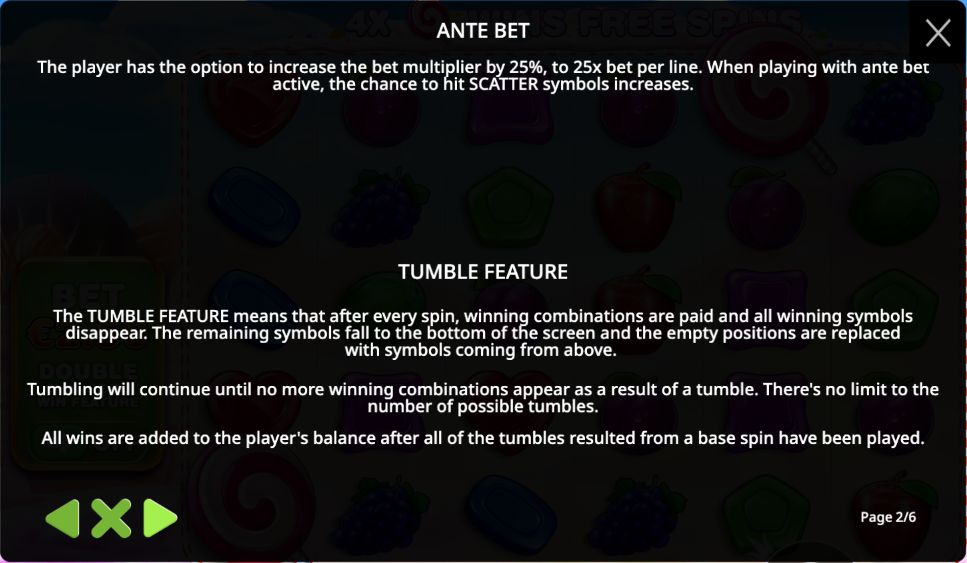
The original Sweet Bonanza demo opened through Zora provides a concrete reference: its screen uses six columns and five visible positions, and its information explains symbol-count awards and tumbles. The key comparison is not that the grid contains many symbols, but that a qualifying count is evaluated without tracing a conventional fixed line. The tumble then continues the same sequence under the title’s rules.
Use separate screenshots for the grid, paytable and feature explanation. Each supports a different statement. A grid proves the observed layout; a paytable explains qualifying counts; a multiplier page explains the scope of an additional rule. One decorative image should not be asked to prove all three or to establish an account-specific return percentage.
Give each candidate its own mechanical identity
For a second Pragmatic title, first record its full name and opened mode. Then ask how wins qualify and what ends one paid round. Do not fill those fields with Sweet Bonanza’s answers merely because the studio is the same. A different game may use lines, connected symbols or another system, and a familiar multiplier label can affect a different calculation base.
A compact comparison can use one row per exact title and columns for evaluation, continuation, multiplier scope and entry cost. Unknown fields remain unknown until supported by that title’s information. This approach is especially helpful with sequels, where visual continuity can make altered feature rules easy to overlook. Popularity is not a substitute for those details.
Compare modes independently from the provider name
If a candidate offers an optional purchase, enhanced mode or distinct bonus entry, attach its complete price and mathematical information to that specific mode. A base-game RTP, where documented, cannot automatically be assigned to every optional action. Likewise, a demo setting does not prove the available real-money configuration on a particular account.
The observed Sweet Bonanza card and demo actually displayed different RTP and volatility statements, reinforcing this need for context. Keep that discrepancy explicit rather than selecting the most favourable figure for the whole provider. A good comparison ends with a clear account of what each screenshot demonstrates and what remains unverified. It does not promise that choosing a studio or feature will produce a better session result.
Use the comparison to answer a specific reader question
A reader moving from a line game may need an explanation of count-anywhere wins; another may want to understand why tumble totals are cumulative. Organise the comparison around that problem, then choose the relevant panel. The useful outcome is a reader who can explain one completed round and identify the cost of the next action. It is not a league table based on unsupported claims about which game pays most often.