Reading a slot grid in Zora
The grid tells you where symbols appear, but not automatically how a win is counted. When opening a slot from Zora, identify the number of reels, the visible positions and the game’s win-evaluation rule. Five columns of symbols can belong to a fixed-line game, a ways game or another design. AlphaCasinoSlots treats the shape as the beginning of inspection rather than a complete description of the mechanics.
Open the help panel and follow one illustrated winning combination. Check whether symbols must start on the leftmost reel, appear consecutively or occupy a defined pattern. A cluster game can instead require connected positions under its own rules. Do not transfer the explanation from a visually similar title: matching artwork or reel count does not establish matching evaluation.
For a simple teaching example, three identical symbols placed diagonally may form a win on an enabled payline but not under a rule requiring a different connection. The example explains why position matters; it is not a paytable for a Zora game. The highlighted result in the actual round and the title’s rules are the relevant reference.
Before comparing stakes, locate the total price of one spin. The number of visible symbols is not necessarily the number of paid lines, and a larger grid does not automatically cost more or offer better expected returns. Record the exact title and provider so the same layout can be found again without confusing it with a sequel.
Describe the screen as coordinates
Number the reels from left to right and the visible positions from top to bottom. This produces an unambiguous description such as reel two, bottom position, instead of “the symbol near the corner”. It is especially helpful when the game shows stacked artwork covering several positions. The artwork can be large while the rules count it as one symbol, several positions or a special object; geometry alone cannot settle that question.
A screenshot becomes useful evidence when its caption identifies the title, mode and relevant positions. Keep enough of the interface to distinguish the grid from a feature animation. A decorative crop of symbols cannot establish which evaluated arrangement produced a return.
Separate three rules that can look similar
Imagine matching symbols on reels one, two and four. A left-to-right consecutive-reel rule may stop at reel two because reel three breaks the sequence. A count-anywhere rule could consider all matching positions, subject to its minimum count. A connected-cluster rule instead asks whether positions touch in the permitted directions. These are deliberately hypothetical alternatives, not interchangeable descriptions of one game.
The exercise is to state the rule before counting the result. Look for the required starting point, continuity and minimum size. If any of those are missing from your explanation, a visually convincing arrangement is still not enough to predict its evaluation. Wilds and special symbols then introduce their own stated exceptions.
A larger grid changes the reading task
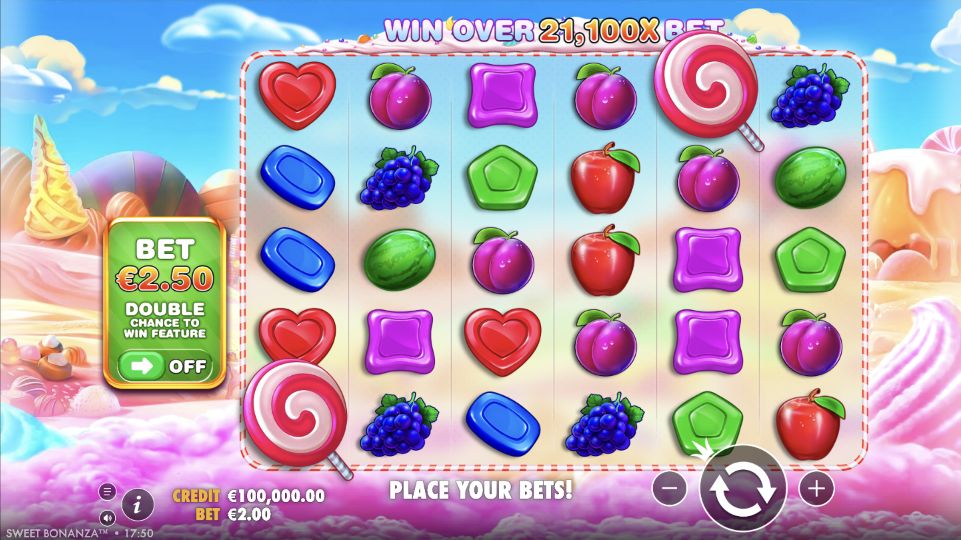
A six-column screen with five visible positions per column contains thirty visible positions. It does not automatically have thirty paylines or thirty independent chances to win. The observed Sweet Bonanza demo on Zora uses a 6×5 display, while its information explains symbol-count evaluation rather than fixed drawn lines. That makes it a useful example of why counting cells is only the first step.
When comparing it with a five-reel line game, keep separate notes for layout and evaluation. The two screens may both show fruit, yet the same diagonal arrangement has no shared mathematical meaning. Compare the total cost and exact rules after identifying the layout; never turn the number of visible positions into a claim about return or safety.