Volatility, hit frequency and the size of a win
Volatility and hit frequency answer different questions about a slot. Volatility describes the spread and unevenness of its results; hit frequency describes how often an outcome meets the game's definition of a hit. Neither tells you that a particular Zora session will win, and a hit is not always a profit on the paid round.
Suppose an illustrative spin costs 1 unit and returns 0.20 units. It may be counted as a winning outcome by the game, but the net result of that spin is minus 0.80 units. A sequence of frequent small returns can therefore reduce a balance. When watching a demo, distinguish the amount displayed as a win from the difference between the opening and closing balance.
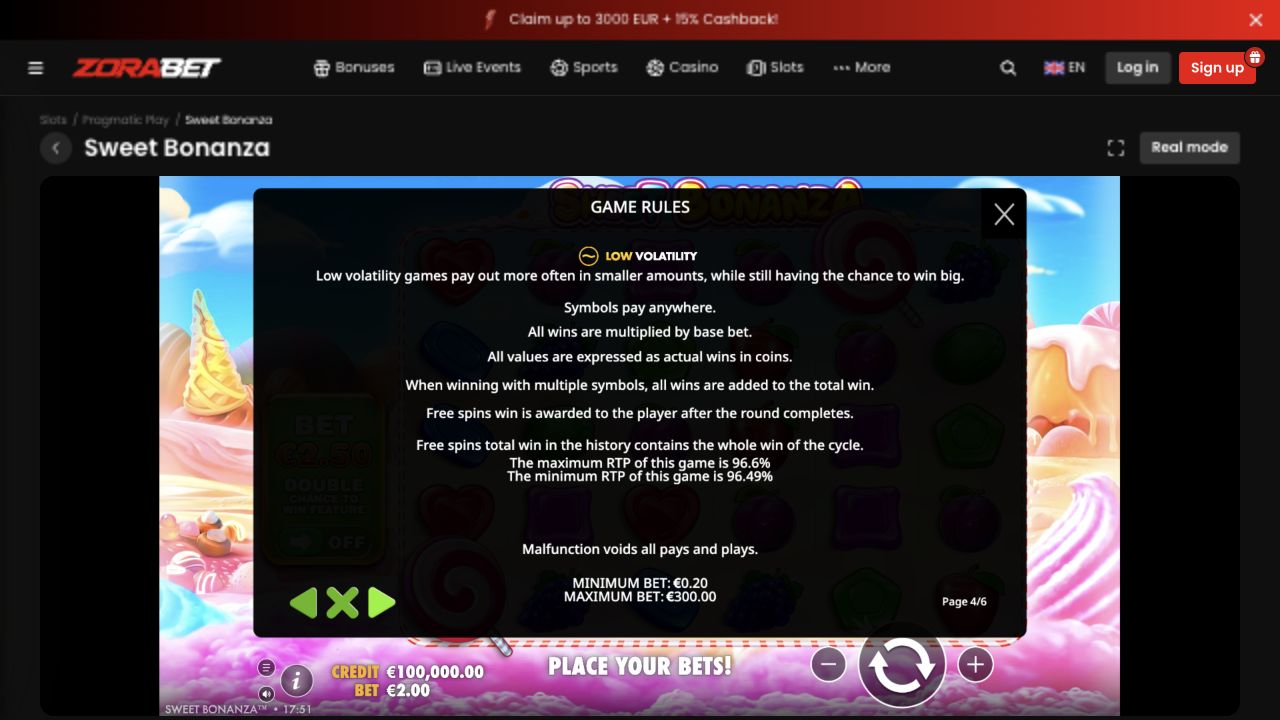
A high-volatility label usually indicates more uneven possible results, but rating scales are not necessarily comparable across providers. Five lightning icons from one studio are not a measured equivalent of five stars from another. If a game does not publish a volatility assessment or hit frequency, do not manufacture one from a short sequence of spins. A handful of rounds is not a reliable sample of its long-run model.
For comparison, record the provider's stated scale, the stake, ordinary symbol payouts and the role of special features. Ask whether you understand the range of potential losses at your chosen stake, rather than whether a label predicts the next result. Reducing stake reduces the amount exposed per round; it does not change the mathematical chance of an already defined outcome.
A return below the stake can still produce a win animation
Consider ten hypothetical rounds costing 1 unit each. Six return 0.20 units and four return zero. A definition that counts any positive return as a hit could report six hits in those ten observations, yet the total return is only 1.20 against 10 staked. The net loss is 8.80. This small teaching sample is not a valid estimate of any game’s hit frequency; it illustrates why the meaning of a hit matters.
Do not rank games by how frequently their animations celebrate. Check the monetary return relative to the total stake. Frequent positive amounts and frequent profitable rounds are different measures, and an interface can make the first more visually noticeable than the second.
Distribution matters even when model returns match
Two mathematical models can share the same theoretical RTP while distributing awards differently. One could place more of its return in smaller events and another in rarer large awards. The percentage alone does not describe that spread. Without published supporting information, a review should not invent a volatility rank from a few screenshots or a handful of rounds.
Provider rating scales also need labels. A value of two on one studio’s own scale is not automatically equivalent to two stars in another system. Keep the source and scale beside the rating. If a catalogue adjective conflicts with the loaded rules, record the mismatch and limit the claim to the observed context.
Use uncertainty to choose a comprehensible commitment
A practical response to unclear distribution is to understand the cost of each decision and set an affordable stopping boundary. Lowering a stake reduces the currency exposed per paid round. It does not make a trigger due, remove the possibility of consecutive losses or convert an unknown model into a predictable one. Faster play increases the number of paid actions within a fixed time without establishing a better chance per action.
For comparison notes, keep three columns: documented mathematical properties, controls you observed, and properties still unconfirmed. This prevents a visual preference or a fortunate demo sequence from becoming an unsupported performance claim. The useful review explains the distinction and lets the reader see exactly what has, and has not, been established. In particular, retain the published definition of a hit when comparing frequency figures.