Find the RTP of the version you actually open
RTP is the theoretical long-run share of stakes returned as prizes under a game's mathematical model. It is not a promise about an individual Zora session. The useful figure is the one stated for the exact version opened in your account, rather than a number copied from another review or a similar title.
A game can have more than one configured return, and optional modes can have their own figures. Open the information or help panel and look for the game's full name, rules version and RTP statement. If separate values appear for ordinary play and a purchased feature, keep them separate. Do not average them or assume the higher figure applies to every paid action.
As a mathematical illustration only, 96% RTP corresponds to a 4% theoretical house edge under the same model. That does not mean a 100-unit deposit will leave exactly 96 units, or that the next spin compensates for earlier losses. RTP uses stakes, including money wagered repeatedly, rather than just the first deposit. A session can finish far above or below the long-run percentage.
If the opened game does not disclose a figure you can identify, say that the configuration has not been confirmed. A provider's catalogue may explain a game family without identifying the configuration available in your account. Save the information-panel date and version when comparing titles; a lobby thumbnail alone cannot verify RTP. Treat the number as one property alongside stake controls, feature costs and volatility.
An observed card and demo disagree
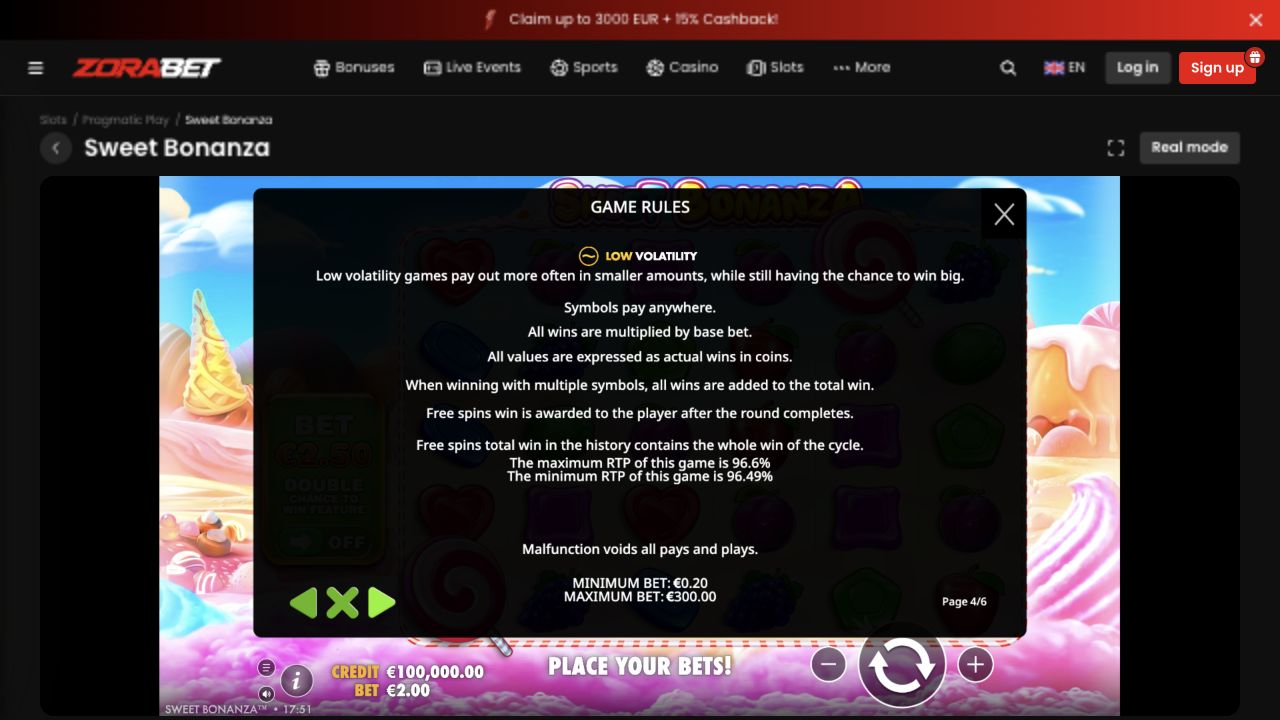
On 9 November 2026, the public Zora page for the original Sweet Bonanza route, ending pragmatic-vs20fruitsw, described 96.48% RTP and high volatility. Opening its Demo mode and then the information panel showed a different statement on Game rules page 4 of 6: minimum RTP 96.49%, maximum RTP 96.6%, alongside a low-volatility label. This is a documented discrepancy between two information surfaces, not proof that one applies to every account.
The practical conclusion is narrow: a lobby description cannot substitute for the rules of the exact loaded build. The observation was made in demo, so it does not verify a real-money configuration. The two displayed RTP values in that demo also need their associated explanation; taking the maximum alone would discard relevant context.
Keep the provenance with each number
A useful comparison record contains the title, provider, mode, page or panel, date and exact scope of the figure. A manufacturer model, operator card and loaded demo panel are three different sources. If they conflict, preserve the conflict rather than averaging the percentages or choosing the more appealing number. Neither arithmetic averaging nor popularity identifies the correct account configuration.
For the Sweet Bonanza observation, the screenshot of page 4 is evidence for what that demo panel displayed. It cannot establish the mathematical model of another edition, an unobserved paid mode or a later session after a configuration change. Keep the public-card claim labelled as a card claim and the demo statement labelled as a demo statement.
Use turnover, not the deposit, in a theoretical example
Suppose a model states 96% RTP and hypothetical total stakes reach 1,000 units through repeated play. The corresponding theoretical average return under that model is 960 units over the relevant long-run framework, with a theoretical difference of 40. This does not predict that one session wagering 1,000 must lose exactly 40. The outcome distribution can produce a much larger loss or a gain.
A deposit of 100 units can support more or less than 100 units of turnover depending on returns and continued play. Applying 4% only to the deposit therefore changes the denominator. Keep theoretical model arithmetic separate from a personal budget or an estimate of how long money will last. A percentage is not an outcome timetable.
An unresolved configuration should stay unresolved
If a money-mode panel is inaccessible or does not identify its return clearly, mark that configuration unconfirmed. The helpful next step is to locate the title’s own information or ask for the exact build’s rules through Zora, not to copy a third-party percentage into the gap. A transparent unanswered field is more accurate than a confident but unrelated number.
RTP also does not resolve volatility or hit frequency. The observed Sweet Bonanza labels make that separation particularly important: preserve what each surface actually says and avoid claiming a short demo run validates either label. Use the rules panel to understand the documented configuration, not to promise that a particular stake or session will perform better.